
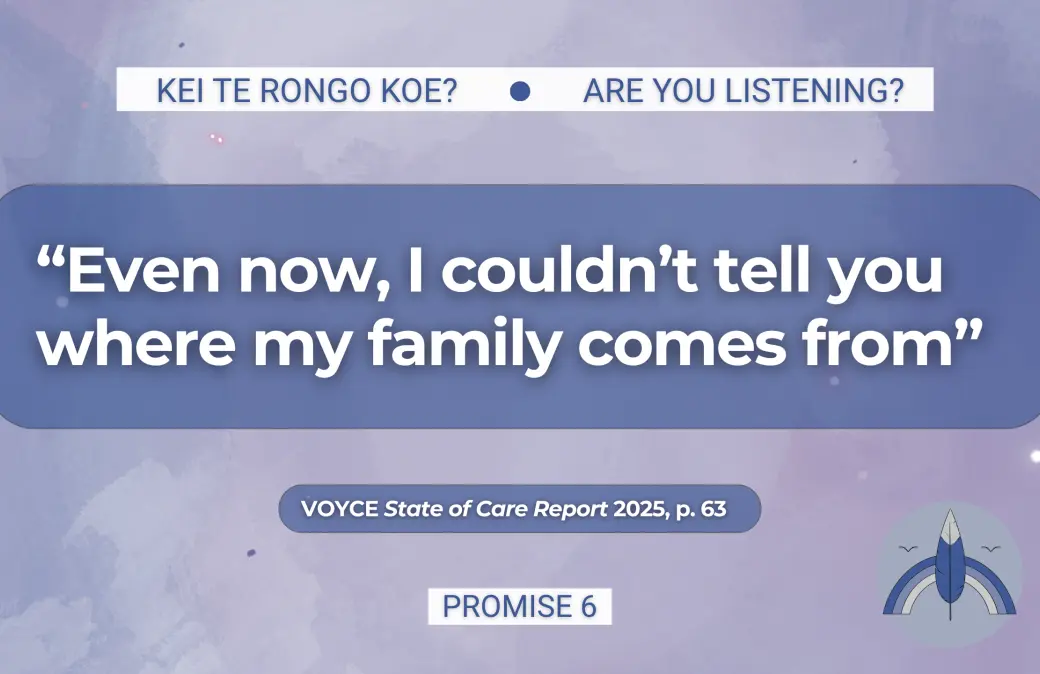

What does identity and belonging look like growing up in care?
In the six months leading up to the election, we have been putting the spotlight on each of the 6 Promises. For the month of October our focus shifted to Promise 6: You promised to help me feel confident in who I am, and learn about my whakapapa, culture and language.
With just one week till the election, we want decision-makers to commit to honouring Promise 6.
This promise is about every care experienced young person knowing who they are, where they come from, and that they belong. Every rangatahi in care deserves to feel safe, accepted, and valued for who they are.
We asked care experienced rangatahi what identity and belonging look like when you’re growing up in care.
Dani, Carmel, and Mons shared with us how placements, missing stories, and decisions made for them affected where they felt they fit. They also shared what brought them home to themselves: whakapapa, culture, faith, whānau and their own tamariki.
Dani
Growing up in care, identity and belonging can sometimes feel like things you’re still trying to find. With different placements, people coming and going, and decisions being made for you, it can be hard to know where you fit in. To me, belonging is feeling safe, accepted and valued for who you are. It’s being connected to your whakapapa, culture, whānau and the people who make you feel at home. Every young person deserves to know they matter, that their voice counts, and that they don’t have to lose who they are just because they’re growing up in care.
CarmelGrowing up in foster care, I always struggled with knowing who I truly was. I wasn't taught much about my culture, my roots, where I came from, or even the story of my own upbringing. For a long time, I felt lost when it came to my identity and where I belonged. But as I've grown older, I've realised that my identity isn't just about where I come from, but also about the people who have loved, raised, and shaped me. My Samoan and Tongan families have given me a sense of belonging, love, and culture that I will forever be grateful for. Now, as a mother of two beautiful children, it's so important to me that my children grow up knowing who they are, where they come from, and that even when parts of our story are missing, we are still worthy, we are still loved, and we still belong. Most importantly, I've found my true identity in Jesus Christ. I am not defined by my past or what I didn't have growing up, but by who God says I am. I am loved, I am chosen, and I am a child of God. ❤️
MonsFor me, growing up in care, my relationship with my identity was fractured and I didn’t feel like I belonged anywhere. My foster parents had told me that my bio dad was in prison my whole childhood. Even though I found out later he didn’t go to prison until I was 16, I grew up super fearful of doing anything wrong and ending up incarcerated like him.
Being a foster kid already made my relationship with my identity really complicated, and thinking my dad was in prison made me feel even more lost and untethered. The choice of connecting with him was taken away from me. I didn’t feel like I belonged anywhere. It was like I was always walking a tight rope, afraid if I did something wrong I would go to prison too. So I felt this intense pressure to be the perfect kid all the time which really impacted my sense of self-worth.
When you’re a foster kid you already feel like you don’t belong because you’re different. Everyone thinking my dad was in prison made me even more of a target for bullies. Because everyone thought my dad was in jail, that's where they expected me to end up. Eventually I started to believe that was what my future would look like too. I disengaged from school, from my friends, and I started using drugs. I had little hope for my life.
The turning point was having my son. He’s a huge part of my identity and the reason I turned my life around. He’s the reason I didn’t follow down that same path. My son connects me to something bigger than myself, and I want to give him the opportunity I never had, to know who he is and where he comes from.
Kei te rongo koe? Are you listening? 👂
-
Election Guide for Care-Experienced Rangatahi
Your Guide to Voting in the Election
Elections come with a lot of jargon, and it’s hard to have your say when no one’s explained how it all works. This page is a resource created by National Care-Experienced Youth Advocate Alchimae Prasad and breaks … -

Care-Experienced Rangatahi to Put Politicians in the Hot Seat Ahead of Election
Care-experienced rangatahi from across Aotearoa will put politicians on the spot ahead of the election, questioning them directly on the issues that matter most to children and young people in care.
-
My Biggest Moves
In the lead up to this year’s election, we are spotlighting one of the 6 Promises each month. For June we have been focusing on Promise 2 – the promise of safety and stability for every child in care.


