
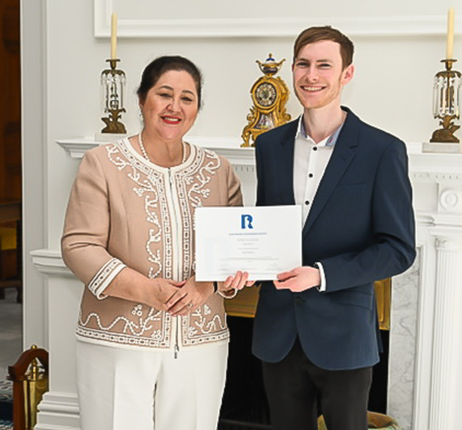
Isaac is a care-experienced young person whose journey shows what’s possible when tamariki in care are supported to thrive. A former VOYCE – Whakarongo Mai Board of Trustees and National Youth Council member, Isaac is also the co-founder and current Chair of the Board for TE4CL – Kia Eke. He is currently completing a Master’s degree in Economics at the University of Oxford and was awarded a prestigious Rhodes Scholar in 2024.
Isaac first came into contact with the care system at just six months old and was placed in permanent care at the age of eight with a whānau he still considers home. While his early years were marked by uncertainty and challenge, Isaac shares that he had a mostly positive experience in care that has shaped his commitment to advocacy – working to ensure more tamariki and rangatahi in care have the support, stability, and opportunities they deserve.
The below reflection has been written by care experienced Rhodes Scholar Isaac, as we take a moment to acknowledge International Day of Education this year (24th January 2026).
It is difficult to overstate the importance of education in my life journey so far, especially while I’m in the midst of my eighth year of tertiary education. I have always loved learning and still do. This began as a somewhat obsessive love of reading, but then over time became a passion for most of my subjects at school and then the three subjects I studied at the University of Otago (Law, Economics and Genetics). I also read a lot in my own time about emerging technology, international affairs, history and philosophy.
Education was also the area of life in which I experienced the most success, even early on. It is difficult to know how much of a difference it made, but I have noticed that my love of reading and success at school fully bloomed after my care situation became more settled. Having stability, and not having to expend the mental energy wondering what might happen next, may have given me the space needed to thrive academically. Another key part of the story is that over time I came to spend what others often saw as excessive time on my schoolwork. I remember my family sometimes wondering why I did this, and that once when I was asked directly I couldn’t think of a good answer. I think a substantial part was my genuine love of learning. However, once I experienced initial success, being someone who was ‘good at school’ became an important part of my identity and I think to some extent I was afraid of losing this if I stopped doing well. I think I have a much more healthy relationship with this now, putting in the effort needed to achieve my aims while pursuing other interests, although I still sometimes don’t get the balance quite right.
The highlight of my education experience has been my time at university, and I am grateful for the support that made it this way. Perhaps the most important factor here is a subtle one – that it was always simply assumed that I would go to university by everyone around me. Through my later foster care advocacy work and learning from other care-experienced rangatahi, I learned how often this is not assumed for those in care.
It has been well-documented that low expectations can be the most important barrier care leavers face to accessing education. Practical support of course matters too. Receiving an Independent Circumstances Allowance after my social worker supported my application, as well as a generous academic excellence scholarship from the University of Otago, made it possible to comfortably focus on study without the pressure of working part-time. While I think my university experience would have been great regardless, this contributed to making it truly exceptional and far less stressful.
Education of course has had practical importance. For me, it meant I now have the option of practising as a lawyer, or taking up economist or policy roles as I have at the Reserve Bank of New Zealand. More recently, it has allowed me to explore a career that brings together my academic interests – policy work to mitigate risks from synthetic biology, especially access to synthetic DNA. Being awarded a Rhodes Scholarship to study at Oxford has provided both a highly regarded postgraduate qualification, which further enhanced my options as many roles require this, and an enriching experience of travel and meeting new people.
Given the barriers care leavers face, I think it is incredibly important that we support care leavers to succeed at all levels of education, including accessing tertiary education if they want to. Unfortunately, this is not something that Aotearoa New Zealand currently does well, especially compared to other countries such as the United Kingdom, which has initiatives like Propel to support care leavers in higher education.
This inspired my co-founder Injy Johnstone and I to create Tertiary Education for Care Leavers (TE4CL) – Kia Eke. This initiative pushes for changes to policy practice in tertiary institutions and government (such as through the Transitions Support Service) to fill this key gap. Please check us out and let us know if you would like to get involved!